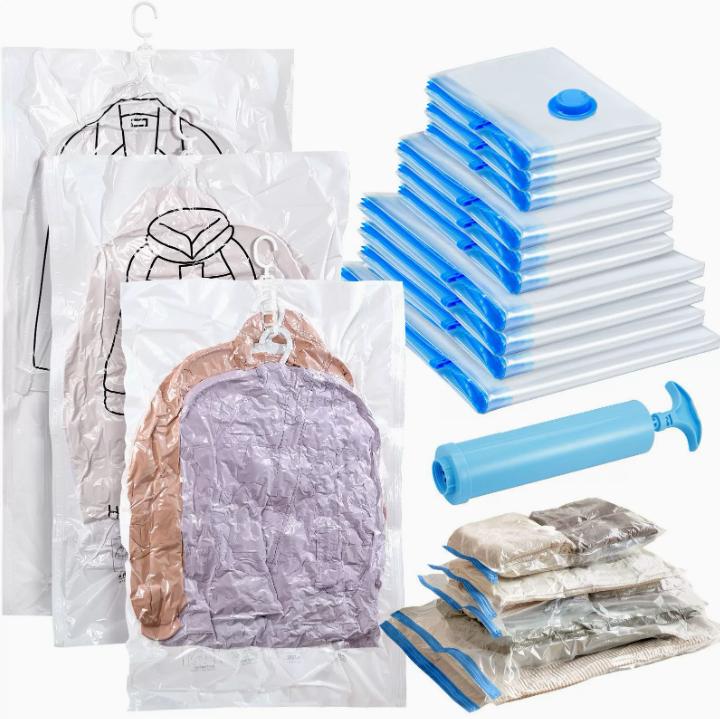
TL;DR — Key Facts at a Glance
| Metric | Data Point |
|---|---|
| Global vacuum packaging market size (2026) | $28.7 billion (Grand View Research) |
| Vacuum storage bag segment CAGR | 6.2% through 2030 |
| Top importing regions | EU (34%), North America (28%), Middle East (12%) |
| Average B2B unit cost (50-micron, medium) | $0.18–$0.35 FOB China |
| Retail price range (Amazon US) | $9.99–$29.99 per set |
| Most common materials | PA+PE (75%), PET+PE (18%), Nylon multilayer (7%) |
| Required certifications for EU/US | CE, FDA 21 CFR 177.1520, REACH, CA Prop 65 |
What Are Vacuum Compression Bags?
Vacuum compression bags — also called space saver bags, vacuum storage bags, or compression storage bags — are flexible packaging products designed to reduce the volume of soft goods (clothing, bedding, textiles) by removing air through a one-way valve. A standard medium-sized bag can compress 4–6 sweaters into a package roughly 25% of their original volume.
The technology rests on three components: a multilayer barrier film (typically PA+PE), a one-way air valve (flat, check, or screw-cap), and a double-track sealing zipper. When air is evacuated — either by a vacuum cleaner hose, a hand pump, or by rolling — atmospheric pressure compresses the contents and the valve prevents re-inflation.
How Big Is the Vacuum Storage Bag Market in 2026?
The broader vacuum packaging market reached approximately $28.7 billion in 2026, driven by e-commerce growth, urbanization, and shrinking living spaces in major cities. Within this, vacuum storage bags for consumer home organization represent a $1.2–$1.8 billion segment, with double-digit growth in emerging markets.
Key demand drivers include: the global tiny home and van life movement, apartment living in megacities (Tokyo, London, New York), seasonal clothing rotation culture in 4-season climates, and the travel compression bag boom post-pandemic.
Anatomy of a Vacuum Compression Bag
Layer Structure (Cross-Section)
- Outer layer (PA — Polyamide/Nylon): Provides puncture resistance and print surface. 15–20 microns.
- Middle layer (Tie resin/Adhesive): Bonds PA to PE. 3–5 microns.
- Inner layer (PE — Polyethylene): Provides heat-sealability and air barrier. 30–50 microns.
- Total thickness: 50–90 microns depending on grade.
Valve Types Comparison
| Type | Airflow Speed | Durability | Unit Cost Impact | Best For |
|---|---|---|---|---|
| Flat valve | Medium | Good | Baseline | Standard retail, Amazon FBA |
| Check valve | Fast | Very good | +$0.03/unit | Premium lines, mattress bags |
| Screw cap | Fastest | Excellent | +$0.08/unit | Reusable/professional grade |
History & Evolution
Vacuum compression for home storage emerged in the late 1990s, pioneered by Japanese and Korean home organization brands responding to extreme urban space constraints. The category gained Western mainstream attention around 2005–2008 with the rise of home shopping TV channels (QVC, HSN). The 2010s brought Chinese manufacturing scale, dropping unit prices by 60% and making the product accessible to mass-market retailers. By 2026, the category has splintered into at least 8 distinct sub-niches: travel, wardrobe/hanging, mattress, moving/relocation, seasonal, baby, pet, and food-grade.
Manufacturing Process: Six Steps from Pellet to Package
- Resin compounding: PA and PE pellets blended with additives (UV stabilizers, slip agents, color masterbatch).
- Blown film extrusion: Multi-layer die head co-extrudes PA+PE film into a continuous tube at 180–220°C.
- Corona treatment: Surface energy treatment for print adhesion.
- Printing: Gravure or flexographic printing (1–8 colors). Digital printing for short runs.
- Bag making: Film tube cut to length, bottom sealed, zipper and valve heat-welded, top open for filling.
- QC & packaging: Each bag inflated and checked for leaks, then folded and packed into retail packaging.
Certification Landscape (2026)
| Certification | Region | What It Covers | Testing Cost (Approx.) |
|---|---|---|---|
| CE Mark | EU | General product safety | $500–$1,500 |
| FDA 21 CFR 177.1520 | USA | Food contact (PE olefin polymers) | $800–$2,000 |
| REACH (EC 1907/2006) | EU | Chemical substance restrictions | $1,000–$3,000 |
| CA Prop 65 | California, USA | Toxic substance warnings | $500–$1,000 |
| OEKO-TEX Standard 100 | Global | Textile safety (for garment-contact use) | $1,500–$4,000 |
Frequently Asked Questions
What’s the difference between vacuum bags and compression bags?
Vacuum bags require a pump or vacuum cleaner to remove air through a valve. Compression bags (roll-up type) use manual rolling to push air out through a one-way vent. Vacuum bags achieve higher compression ratios (75–80% volume reduction vs. 50–60% for roll-up).
How long do vacuum storage bags hold their seal?
Quality PA+PE bags with welded valves maintain seal for 6–12 months under normal conditions. PET+PE bags typically hold 3–6 months. Temperature fluctuations and sharp object contact are the two biggest causes of premature seal failure.
Are vacuum storage bags food-safe?
Only if specifically labeled and certified as food-grade. Standard home storage vacuum bags use industrial-grade PA and PE resins that are not certified for food contact. Food-grade versions require FDA 21 CFR or EU 10/2011 compliance and cost 40–60% more at wholesale.
What micron thickness should I order?
50-micron: Economy/entry-level, OK for light seasonal storage. 70-micron: The B2B sweet spot — good durability at competitive pricing. 90-micron: Premium/heavy-duty, for mattress bags, frequent reuse, professional moving.
Key Industry Terms Defined
- Blown film extrusion: Manufacturing process where molten plastic is inflated into a bubble and cooled into a thin tube.
- Co-extrusion: Simultaneous extrusion of multiple polymer layers through a single die.
- Corona treatment: Electrical discharge that increases surface energy of plastic film for ink adhesion.
- Dart drop test: Impact resistance test — a weighted dart is dropped onto stretched film.
- Gel count: Number of unmelted resin particles per square meter — indicates film quality.
- Slip agent: Additive (typically erucamide) that reduces film surface friction for easier bag opening.
Sources: Grand View Research vacuum packaging report; FDA 21 CFR 177.1520; EU REACH Regulation EC 1907/2006; OEKO-TEX Standard 100; industry manufacturing data.