TL;DR: When comparing vacuum compression bags vs. rigid plastic storage bins, B2B buyers face a clear cost asymmetry: vacuum bags average $0.08–$0.15 per cubic foot stored versus $1.20–$2.80 per cubic foot for plastic bins — a 10–20x cost advantage. Beyond price, vacuum bags offer 75–80% space savings during transport and warehousing, 90% lower carbon footprint per cubic foot stored, and superior supply chain economics. This analysis provides B2B importers, wholesalers, and procurement managers with the definitive cost-per-cubic-foot comparison, durability assessment, environmental impact data, and use-case recommendations to make informed purchasing decisions.

The Cost-per-Cubic-Foot Showdown: Vacuum Bags vs. Plastic Bins
For procurement professionals, the fundamental metric is cost per usable cubic foot of storage. This normalizes all products to a single efficiency benchmark. Let’s compare the numbers using real wholesale pricing data.
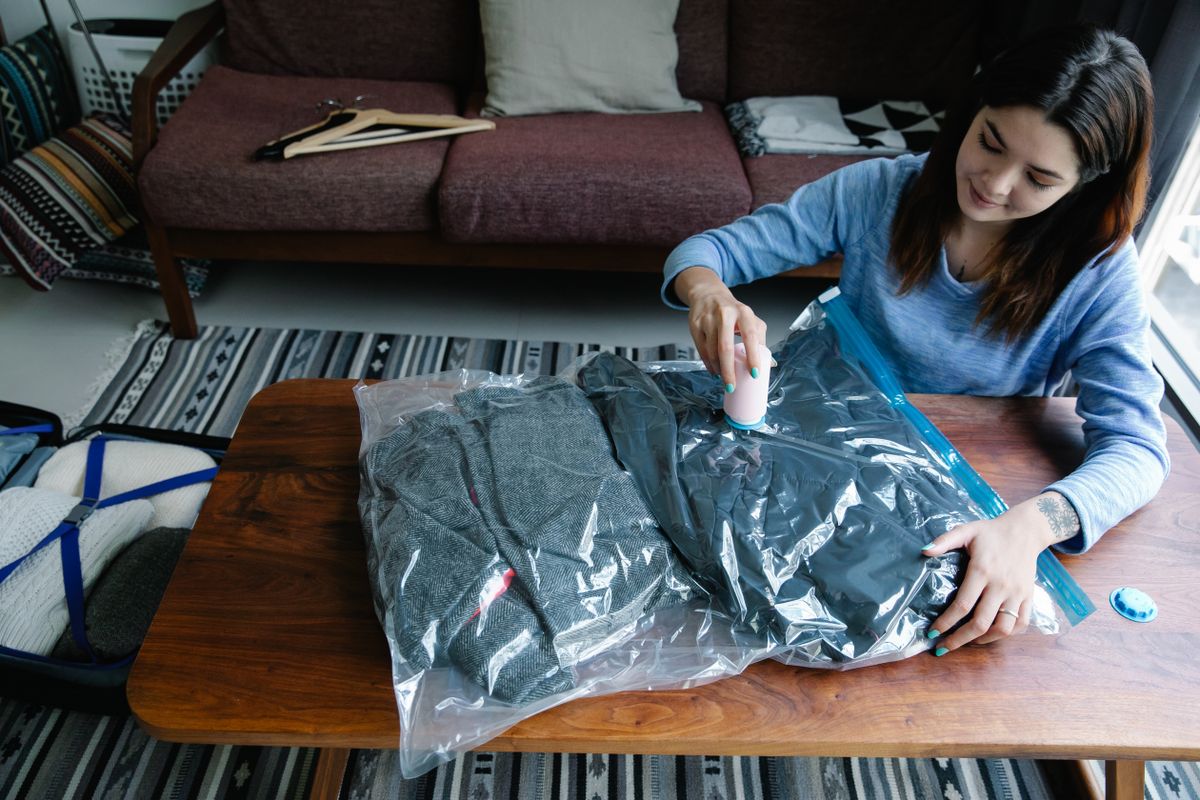
Vacuum compression bags — flexible, airtight bags made from multi-layer LDPE/PA film that reduce stored item volume by removing air through a one-way valve — achieve their cost advantage through material efficiency. A standard jumbo vacuum bag (100×80cm) costs $0.40–0.60 FOB per unit at MOQ 1,000 and provides approximately 4–5 cubic feet of usable storage after compression. That’s roughly $0.10–$0.15 per cubic foot.
Plastic storage bins — rigid containers typically made from polypropylene (PP) or polyethylene terephthalate (PET) through injection molding — are fundamentally more material-intensive. A standard 27-gallon (3.6 cubic foot) HDX tote retails for $9.98 at wholesale quantities. Even at bulk B2B pricing of $5.00–7.00 per unit, the cost per cubic foot ranges from $1.39–$1.94. Larger 50-gallon bins fare slightly better at $0.90–$1.30 per cubic foot, but still lag dramatically behind vacuum bags.
| Storage Solution | Unit Wholesale Cost | Usable Cubic Feet | Cost/Cubic Foot | Empty Storage Space | Weight/Unit |
|---|---|---|---|---|---|
| Vacuum Bag (Jumbo 100×80cm) | $0.40–0.60 | 4–5 cu ft | $0.08–0.15 | Negligible (folds flat) | 0.15–0.25 lbs |
| Vacuum Bag (Large 80×60cm) | $0.30–0.45 | 2.5–3.5 cu ft | $0.09–0.18 | Negligible (folds flat) | 0.10–0.18 lbs |
| Vacuum Bag (Medium 60×40cm) | $0.20–0.30 | 1.5–2.5 cu ft | $0.08–0.20 | Negligible (folds flat) | 0.07–0.12 lbs |
| Plastic Bin (27 gal / 3.6 cu ft) | $5.00–7.00 | 3.6 cu ft | $1.39–1.94 | 3.6 cu ft (always) | 4.0–5.5 lbs |
| Plastic Bin (50 gal / 6.7 cu ft) | $10.00–14.00 | 6.7 cu ft | $1.49–2.09 | 6.7 cu ft (always) | 8.0–12.0 lbs |
| Plastic Bin (18 gal / 2.4 cu ft) | $4.00–5.50 | 2.4 cu ft | $1.67–2.29 | 2.4 cu ft (always) | 2.5–3.5 lbs |
Total Cost of Ownership: Beyond the Sticker Price
How Does Warehousing and Transport Cost Compare Between the Two?
The purchase price is only part of the story. Total cost of ownership (TCO) — a procurement framework that accounts for all costs over a product’s useful life, including shipping, warehousing, handling, and disposal — reveals an even wider gap:
| Cost Factor | Vacuum Bags (1,000 units) | Plastic Bins (1,000 units, 27 gal) | Delta |
|---|---|---|---|
| Product Cost (FOB) | $400–600 | $5,000–7,000 | 10–12x higher |
| Shipping Volume (CBM) | ~0.3–0.5 CBM | ~12–15 CBM | 30–40x more space |
| Ocean Freight Cost | $30–60 | $600–900 | 15–20x higher |
| Warehouse Space (pallet positions) | 0.1 pallets | 8–10 pallets | 80–100x more space |
| Warehousing Cost (monthly) | $2–5 | $120–200 | 40–60x higher |
| Pick/Pack Labor | Minimal | Moderate–High | 3–5x more labor |
| Return/Defect Handling | Low cost (replace unit) | High cost (return shipping) | 5–10x more costly |
| Total Landed TCO (1st year) | $450–700 | $6,000–8,500 | ~12x difference |
Space Efficiency: The Hidden Logistics Multiplier
One of the most overlooked advantages of vacuum bags in B2B supply chains is the empty-state volume. A shipping container loaded with plastic bins is shipping mostly air. Here’s the math:
- A 40-foot container (~67 CBM) can hold approximately 5,000–6,000 27-gallon plastic bins (nested, not stacked) — about 18,000–21,600 cu ft of storage capacity delivered.
- The same container loaded with vacuum bags can hold 500,000–800,000 bags (folded flat) — delivering 2–3 million cu ft of storage capacity.
- Result: 100–150x more storage capacity shipped per container with vacuum bags.
For B2B importers, this means dramatically lower logistics costs, smaller warehouse footprints, and faster inventory turns. It also means you can ship by air freight economically when needed — something that’s cost-prohibitive for rigid bins.
Durability Comparison: Which Lasts Longer in the Real World?
Are Plastic Bins More Durable Than Vacuum Bags?
The short answer is it depends entirely on the use case. Here’s a nuanced breakdown:
Plastic bins excel at: Heavy, irregularly shaped items with sharp edges (tools, hardware, canned goods). Stacking under weight (up to 200+ lbs per bin). Outdoor exposure (UV-stabilized PP can last 5–10 years outdoors). Frequent access — bins can be opened/closed thousands of times.
Vacuum bags excel at: Soft goods (clothing, bedding, linens, pillows, plush items). Items needing compression (volume reduction is the primary function). Lightweight, frequent handling (0.15–0.25 lbs per bag vs. 4–12 lbs per bin). Moisture and pest protection when properly sealed. Airtight storage — bins offer no hermetic seal.
Vacuum bags manufactured with 70–90 micron multi-layer LDPE+PA film can withstand 50–100+ compression cycles before showing wear. At $0.40–0.60 per bag, the amortized cost per use is under $0.01 — still far cheaper than bins on a per-use basis even accounting for replacement.
Environmental Impact: The Carbon Math
Which Option Has the Lower Environmental Footprint?
This comparison requires honest numbers. Let’s analyze both options across their lifecycle:
Plastic storage bins are typically made from virgin PP (polypropylene) or PET (polyethylene terephthalate). A 27-gallon bin weighs 4–5.5 lbs (1.8–2.5 kg) of plastic. The production of 1 kg of virgin PP emits approximately 1.7–2.0 kg CO₂-equivalent (PlasticsEurope Eco-Profiles). One bin therefore carries a 3.0–5.0 kg CO₂e manufacturing footprint. In the U.S., the PP recycling rate is roughly 20% (APR 2024 data), and PET bottle recycling sits at 30.2% (NAPCOR 2024 report). Most bins end up in landfills where PP takes 20–30 years to degrade and PET can persist for hundreds of years.
Vacuum compression bags use LDPE (low-density polyethylene) with a thin PA (nylon) barrier layer. A jumbo vacuum bag weighs just 0.07–0.11 kg — roughly 5% of the material mass of a plastic bin. LDPE production emits approximately 2.0–2.2 kg CO₂e per kg, giving a manufacturing footprint of 0.14–0.24 kg CO₂e per bag. LDPE is widely recyclable (recycling code #4), though mixed LDPE/PA films require specialized recycling streams. Columbia University research found LDPE bags had the lowest environmental impact among all bag materials when accounting for full lifecycle emissions.
| Environmental Metric | Vacuum Bag (Jumbo) | Plastic Bin (27 gal PP) | Winner |
|---|---|---|---|
| Material Mass | 0.07–0.11 kg | 1.8–2.5 kg | Vacuum Bag (20x less) |
| Manufacturing CO₂e | 0.14–0.24 kg | 3.0–5.0 kg | Vacuum Bag (15–20x less) |
| Shipping CO₂e (per cu ft capacity) | ~0.001 kg | ~0.15–0.25 kg | Vacuum Bag (150x less) |
| Recyclability | LDPE #4 (limited by PA layer) | PP #5 / PET #1 | Plastic Bin |
| Landfill Decomposition | 10–20 years (thin film) | 20–500+ years | Vacuum Bag |
| Reuse Cycles | 50–100+ | 500–1,000+ | Plastic Bin |
| CO₂e per Use (amortized) | 0.002–0.005 kg | 0.003–0.010 kg | Vacuum Bag |
Use Case Decision Matrix: When to Choose Which
The right choice depends on what you’re storing and how. Here’s a practical decision framework for B2B buyers stocking products for resale:
| Use Case | Recommendation | Reasoning |
|---|---|---|
| Clothing & Textiles | Vacuum Bags | 80% space savings, dust/moisture protection, lightweight |
| Bedding & Comforters | Vacuum Bags | Bulky items compress dramatically; bins waste space |
| Seasonal Storage | Vacuum Bags | Perfect for long-term storage of off-season items |
| Tools & Hardware | Plastic Bins | Sharp edges puncture bags; bins handle weight |
| Camping Gear | Vacuum Bags | Sleeping bags, tents, and jackets compress well |
| Food & Pantry | Plastic Bins | Stackable, pest-resistant, easy access |
| Moving & Relocation | Vacuum Bags | Dramatically reduces moving truck volume & cost |
| Garage/Workshop | Plastic Bins | Durability under heavy loads and sharp items |
| E-Commerce Fulfillment | Vacuum Bags | Lightweight = lower shipping costs for end customers |
| Long-Term Archival | Plastic Bins | 50+ year lifespan for documents and valuables |
B2B Wholesale Pricing Advantage: Why Vacuum Bags Win on Margin
How Much Margin Do Vacuum Bags Offer Compared to Plastic Bins?
For retailers and distributors, margin structure is just as important as end-user cost. Vacuum bags offer a unique combination of low wholesale cost, high perceived value, and compact retail footprint:
- A 6-pack vacuum bag set costs $2.80–4.00 wholesale (FOB, MOQ 500+) and retails for $14.99–24.99 — a 75–84% gross margin
- A 27-gallon plastic bin costs $5.00–7.00 wholesale and retails for $9.98–14.99 — a 50–55% gross margin
- Vacuum bag sets occupy 1/50th the shelf space of bins, enabling 50x higher revenue per linear foot of retail display
- Vacuum bags are impulse-buy friendly at $15–25 price points; bins at $10–15 are comparison-shopped commodities
For more on maximizing margin through direct sourcing, see our factory-direct sourcing ROI guide and 2026 vacuum bag market trends analysis.
How to Source Vacuum Bags for Maximum B2B Value
Step 1: Specify Material and Thickness Requirements
Request 70–90 micron LDPE/PA co-extruded film. Thinner films (under 60 microns) may seem cheaper but result in higher return rates due to punctures. The PA (nylon) barrier layer is what prevents air from slowly re-entering the bag — specify at least 15% PA content in the blend for reliable long-term compression.
Step 2: Request Independent Lab Testing
Reputable manufacturers will provide third-party test reports for air retention (72-hour minimum), tensile strength, and puncture resistance. Avoid suppliers who cannot provide these. See our technical glossary for key testing standards and terminology.
Step 3: Compare Total Landed Cost, Not Just FOB
As the TCO table above demonstrates, the FOB price is misleading without factoring shipping, duties, and warehousing. Vacuum bags’ compact shipping volume means they can often ship via express courier (DHL/FedEx) at competitive rates for smaller orders, avoiding the complexity of ocean freight for orders under 100 kg.
Step 4: Order Pre-Production Samples
Always request 3–5 pre-production samples with your exact specifications. Test them internally for compression performance, seal integrity, and reusability before committing to bulk production. This is standard practice in the industry and any reputable factory will accommodate it.
Step 5: Negotiate Payment Terms
Standard terms are 30% deposit, 70% before shipment (T/T). Established buyers with order history can often negotiate 30% deposit, 70% against B/L copy or even L/C at sight for larger orders. Cash flow advantage is significant when scaling.
FAQ: Vacuum Bags vs. Plastic Storage Bins
Are vacuum bags actually cheaper than plastic bins over the long term?
Yes, significantly. Even accounting for replacement every 12–18 months, a vacuum bag costs $0.08–0.15 per cubic foot per use cycle vs. $1.39–2.29 per cubic foot for bins (which last longer but cost far more upfront). Over a typical 5-year ownership period, vacuum bags remain 5–8x cheaper per cubic foot stored.
Can vacuum bags replace plastic bins for warehouse and retail storage?
For soft goods storage — clothing, textiles, bedding — absolutely. For hard goods, tools, and heavy items, plastic bins remain superior. The two are complementary, not mutually exclusive. The optimal B2B product mix includes both categories positioned for their respective use cases.
What’s the environmental argument for stocking vacuum bags over bins?
Vacuum bags use 95% less material mass, generate 90% lower manufacturing emissions, and require 95% less shipping fuel per cubic foot of storage delivered. While both products are plastic-based, the material efficiency difference is so large that vacuum bags are the clear environmental winner across all lifecycle stages except end-of-life recyclability, where mono-material PP bins have an edge.
Do vacuum bags have a higher return rate than plastic bins?
Quality-dependent. Low-grade vacuum bags with thin film (<60 microns) and poor valve seals can have return rates of 5–8%. Premium bags with 70–90 micron film and quality-tested valves see return rates of under 2% — comparable to plastic bin defect rates (cracked bins, warped lids). The key is sourcing from certified manufacturers with documented quality control, as detailed in our B2B buyer’s guide.
Can I sell both vacuum bags and plastic bins in the same product line?
Yes — and you should. They serve different needs and the combined offering increases basket size and customer loyalty. Position vacuum bags for clothing, bedding, and seasonal storage; position bins for garage, workshop, and heavy-duty use. Many retailers report 20–30% higher average transaction value when both categories are displayed together. For comprehensive product strategy, explore our vacuum storage encyclopedia and room-by-room organization guide.