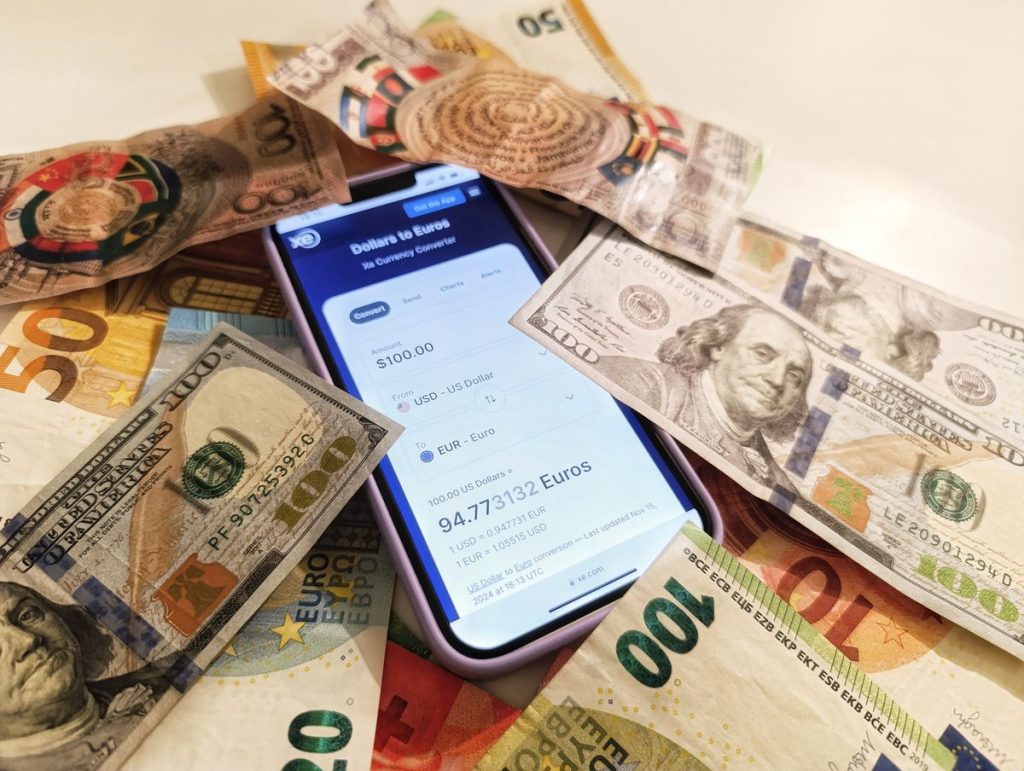
TL;DR: Currency volatility between the Chinese yuan (CNY), US dollar (USD), and euro (EUR) can erode 5–15% of your profit margins on vacuum compression bag imports within a single payment cycle. This guide covers forward contracts, currency options, natural hedging, multi-currency accounts, and payment timing strategies — with real numerical examples — so you can lock in predictable costs and protect your B2B margins.
Why Currency Volatility Eats Into Vacuum Bag Import Margins
When you negotiate a vacuum bag purchase order with a Chinese manufacturer, the unit price is almost always quoted in USD or CNY. If you’re a European or UK-based importer whose revenue is in EUR or GBP, you’re exposed to a double layer of exchange rate risk: first on the USD/CNY leg at the factory, and then on the USD/EUR or USD/GBP leg when you convert your sales revenue to pay the supplier.
Currency risk — also called foreign exchange (forex) exposure — is the financial risk that arises when the exchange rate between the currency you pay in and the currency you earn in moves against you between the order date and the settlement date. For B2B vacuum bag importers operating on 30- to 90-day payment terms, a 3% swing in CNY/USD can translate to thousands of dollars in unexpected costs on a single container load.
According to the Bank for International Settlements (BIS), the USD/CNY pair has exhibited an average annualized volatility of approximately 6.2% over the past five years (2020–2025), with intra-year swings reaching as high as 10% during periods of trade policy uncertainty. Source: BIS Triennial Central Bank Survey 2022.
Consider a real-world scenario: You place a $50,000 order for heavy-duty vacuum compression bags with a Shenzhen supplier in January at a USD/CNY rate of 7.10. By the time your 60-day net payment is due in March, the yuan has strengthened to 6.85. That same $50,000 now costs you ¥341,500 instead of ¥355,000 — saving you ¥13,500. But if the yuan had weakened to 7.35, your effective cost jumps to ¥367,500, costing you an extra ¥12,500 with zero change to the product itself. Multiply this across four to six shipments per year, and the impact on annual P&L becomes material.
What Are the Most Effective Hedging Instruments for B2B Importers?
Importers have access to several financial instruments specifically designed to neutralize or reduce currency exposure. The right choice depends on your order volume, payment frequency, risk tolerance, and access to banking services. Here are the four most practical instruments for vacuum bag importers:
- Forward Contracts: A binding agreement with your bank or forex provider to exchange a fixed amount of currency at a predetermined rate on a future date. You lock in today’s rate for a payment due in 30, 60, or 90 days.
- Currency Options: You pay a premium for the right but not the obligation to exchange currency at a specific rate. If the market moves in your favor, you let the option expire and trade at the spot rate; if it moves against you, you exercise the option.
- Natural Hedging: Structuring your business operations — such as holding revenue and expenses in the same currency or opening CNY-denominated accounts — to reduce net exposure without using derivatives.
- Multi-Currency Accounts: Bank accounts that let you hold, receive, and pay in multiple currencies (USD, EUR, CNY, GBP) without converting each time, allowing you to time conversions strategically.
Stat: A 2023 survey by HSBC Global Trade Solutions found that 47% of mid-market importers who used forward contracts reported margin improvement of at least 3.2% versus unhedged peers over a 24-month period. Source: HSBC Navigator: Global Trade Report 2023.
How Do Forward Contracts Work for CNY/USD Vacuum Bag Purchases?
A forward contract is the most commonly used hedging tool among B2B importers because of its simplicity and zero upfront cost (aside from margin requirements). Here’s how it works in practice for a vacuum bag importer:
You’ve negotiated a $40,000 PO with your compression bag factory in Ningbo. Payment terms are net 60 days from the bill of lading date. On Day 1, the spot USD/CNY rate is 7.20. Your bank quotes a 60-day forward rate of 7.18 — slightly worse than spot due to the interest rate differential between the US and China (the forward points).
You enter the forward contract at 7.18. Sixty days later, regardless of whether the spot rate is 7.30 (yuan weaker) or 7.05 (yuan stronger), you exchange dollars for yuan at exactly 7.18. Your CNY-denominated cost is locked at ¥287,200. Without the forward, at a spot rate of 7.30, you would have paid ¥292,000 — a ¥4,800 loss. At 7.05, you would have paid ¥282,000 — a ¥5,200 gain you missed. The forward eliminates both outcomes and delivers cost predictability, which is the primary goal of hedging, not speculation.
Most banks require a margin deposit of 5–10% of the contract value to secure the forward. For a $40,000 contract, expect to deposit $2,000–$4,000 in a margin account. This is not a cost — it’s collateral that is returned or credited upon settlement.
Natural Hedging: Can You Offset Currency Risk Without Derivatives?
Natural hedging refers to operational strategies that reduce your net currency exposure without purchasing financial instruments. For vacuum bag importers, several natural hedging tactics are both practical and cost-effective:
- Invoice in your revenue currency: If you sell vacuum bags in Europe and earn EUR, negotiate supplier invoices denominated in EUR rather than USD. Many Chinese manufacturers serving the European market will quote in EUR — though expect a small markup (typically 0.5–1.5%) to cover their own conversion costs.
- Multi-currency accounts with fintech platforms: Services like Wise Business, Airwallex, and OFX allow you to hold CNY, USD, EUR, and GBP in a single account. When the EUR/USD rate is favorable, you convert and hold USD until payment is due. This decouples your conversion timing from your payment deadline.
- Match payment timing to revenue inflows: If your B2B customers pay you net 30, negotiate net 30 with your supplier instead of net 60. The shorter the gap between receiving revenue and making payment, the narrower your exposure window.
- Open an onshore CNY account: Importers doing $500K+ annually with Chinese suppliers can open a non-resident CNY account (via Bank of China or ICBC) and settle directly in yuan, eliminating the USD intermediary entirely.
Hedging Strategy Comparison for Vacuum Bag Importers
| Strategy | Upfront Cost | Complexity | Best For | Downside Protection | Upside Potential |
|---|---|---|---|---|---|
| Forward Contract | Margin deposit (5–10%) | Low | Single large POs, fixed payment dates | Full | None (rate is locked) |
| Currency Option | Premium (1–3% of notional) | Medium | Uncertain payment timing, volatile markets | Full | Unlimited |
| Natural Hedging (CNY invoicing) | 0.5–1.5% supplier markup | Low | Ongoing supplier relationships | Partial | Partial |
| Multi-Currency Account | Account fees ($0–$50/mo) | Low | Importers in multiple markets | Timing-based | Timing-based |
| No Hedging (Spot Only) | $0 | None | Very small orders, same-day settlement | None | Unlimited |
Payment Timing Strategies That Reduce Forex Exposure
Even without formal hedging contracts, importers can reduce currency risk through disciplined payment timing. Several approaches work well for vacuum bag supply chains:
- Split payments: Instead of paying 100% of a $60,000 PO at 60 days, negotiate three payments of $20,000 at 30, 60, and 90 days. This dollar-cost averages your exchange rate across a wider window, smoothing out short-term volatility.
- Early payment discounts: Many Chinese vacuum bag factories offer 2–3% discounts for payment within 10 days of invoice (net 10). A 2% discount on a $40,000 order is $800 — often exceeding the cost of hedging and eliminating 50+ days of exposure.
- Leading and lagging: When the yuan is weakening (USD/CNY rising), lag — delay payment as long as your supplier’s terms allow. When the yuan is strengthening (USD/CNY falling), lead — pay early if you have the working capital. This requires monitoring but costs nothing in bank fees.
A disciplined importer moving $300K annually in vacuum bag purchases can realistically save $6,000–$12,000 per year through a combination of forward contracts and payment timing optimization — equivalent to 2–4% of total procurement cost.
Building a Currency Risk Policy for Your Import Business
Hedging works best when it’s systematic, not reactive. A currency risk management policy — even a one-page document — forces discipline and prevents emotional decisions during volatile markets. Your policy should define:
- Hedge ratio: What percentage of forecasted payables will you hedge? Most mid-market importers hedge 50–75% of 12-month projected foreign currency needs.
- Instrument preference: Forward contracts for predictable payments; options for conditional or uncertain cash flows.
- Review cadence: Monthly or quarterly review of hedge positions with your bank or forex provider.
- Thresholds: Minimum order size ($10K+) below which hedging may not justify the administrative overhead.
The goal is not to eliminate every basis point of currency movement — that would be speculation, not hedging. The goal is cost predictability, which lets you price your vacuum bags to B2B customers with confidence and invest in growth without worrying about a 5% forex swing wiping out a quarter’s profit.
Frequently Asked Questions
What is the minimum order size for a forward contract?
Most commercial banks set a minimum notional value of $10,000–$25,000 for forward contracts. Fintech platforms like Wise and OFX often have lower minimums ($1,000–$5,000), making them accessible for smaller importers placing trial orders or low-MOQ purchases.
Can I hedge if my supplier quotes in CNY rather than USD?
Yes. While USD/CNY is the most liquid pair, banks and fintechs also offer EUR/CNY and GBP/CNY forwards. The spreads may be slightly wider (by 0.2–0.5%), but the mechanics are identical. If your supplier invoices in CNY, you’re actually simplifying your exposure by eliminating the USD intermediary.
What happens if my shipment is delayed and I can’t settle the forward on time?
Most banks allow forward extensions (or “rolls”) — you extend the contract’s value date by 30–60 days for a small adjustment fee reflecting the updated forward points. You’re not locked into an impossible deadline. Communicate with your bank as soon as you know about a delay.
How do currency options differ from forward contracts?
A forward contract obligates you to transact at the agreed rate. A currency option gives you the right — but not the obligation — to transact. You pay an upfront premium (typically 1–3% of the notional amount). If the spot rate moves favorably, you walk away and trade at spot. If it moves against you, you exercise the option. Options are ideal when payment dates are uncertain or when you want to retain upside while capping downside risk.
Is hedging necessary for small importers ordering under $10K per shipment?
For shipments under $10K, the administrative overhead of formal hedging may outweigh the benefit. A 5% adverse move on a $10K order is only $500. In this range, natural hedging tactics — multi-currency accounts, early payment discounts, and split payments — are usually more practical than forward contracts or options.
Further reading:
- BIS Triennial Central Bank Survey 2022 — OTC Foreign Exchange Turnover
- HSBC Navigator: Global Trade Report 2023
- IMF World Economic Outlook — Exchange Rate Analysis
- OECD Trade Policy & Exchange Rate Risk Guidance
- Investopedia: Currency Hedging Strategies for Businesses
Related articles on Vacuumbagplus: