TL;DR: Batch traceability and lot control are not optional for professional vacuum bag sourcing. From raw resin lots to finished pouch shipments, every production stage must be documented to meet ISO 9001 requirements, support rapid recall response, and satisfy retailer compliance audits. This guide covers lot numbering systems, QR code tracking, backward/forward traceability, and how to verify your supplier’s traceability infrastructure before placing an order.

What Is Batch Traceability in Vacuum Bag Manufacturing?
Batch traceability is the ability to track every component of a vacuum bag—from the raw plastic resin pellet through extrusion, printing, slitting, pouch-making, and final packaging—back to its origin and forward to its destination. A lot number (or batch number) is a unique identifier assigned to a production run that links all materials, processes, inspections, and finished goods to a single traceable unit.
In vacuum bag production, a single manufacturing lot typically consists of 5,000–50,000 pouches produced from a consistent set of raw materials under uniform process conditions. If a defect is discovered—say, a seal integrity failure traced to a specific resin batch—the manufacturer must be able to identify every finished pouch that used that resin within hours, not days.
Forward traceability answers: “Where did this material lot end up?” It traces defective raw material forward to every finished pouch and customer shipment. Backward traceability answers: “Where did this finished pouch come from?” It traces a failed bag back to the specific resin lot, extrusion machine, operator shift, and quality inspection records.
According to WorkCell’s manufacturing traceability research, only about 23% of factories have full traceability systems in place. The average product recall costs $10 million in direct expenses, and companies with weak traceability pay up to 70% more per recall because they cannot isolate affected lots and end up pulling everything.
For vacuum bag importers—whether you’re sourcing food-grade pouches for a retail private label or heavy-duty industrial bags for a distribution network—your supplier’s traceability system directly impacts your brand protection, regulatory compliance, and financial exposure.
How Does ISO 9001 Mandate Traceability for Vacuum Bag Suppliers?
ISO 9001:2015 is the international standard for quality management systems, and Clause 8.5.2 specifically addresses identification and traceability. The standard requires organizations to “use suitable means to identify outputs when it is necessary to ensure the conformity of products and services” and to “identify the status of outputs with respect to monitoring and measurement requirements throughout production and service provision.”
In practice, this means your vacuum bag supplier must:
- Assign unique identification (lot numbers) to incoming raw materials—PE resin, nylon film, EVOH barrier layers, ink batches, and packaging cartons
- Maintain lot identification through every production step: extrusion → printing → lamination → slitting → pouch-making → QC inspection → packaging
- Record which material lots were consumed in each production work order
- Link finished product lot numbers to specific customer shipments
- Retain traceability records for a defined period (typically 3–5 years minimum)
During ISO 9001 surveillance audits, auditors will test the traceability system with a “mock recall” exercise: they select a finished product serial number and ask the manufacturer to trace it backward to all raw material inputs within a specified time window—often 4 hours or less. Suppliers who cannot complete this exercise risk major nonconformities and potential certification suspension.
For B2B buyers, the key question to ask is: “Can your team complete a full backward and forward trace within 4 hours?” If the answer is “we’d need a couple of days,” you are sourcing from a supplier whose quality infrastructure is not production-grade.
What Lot Numbering Systems Do Professional Vacuum Bag Manufacturers Use?
A well-designed lot numbering system is the backbone of traceability. Professional vacuum bag manufacturers typically use a structured, human-readable format that encodes critical production data without requiring a database lookup.
Common lot numbering components include:
| Component | Example Code | What It Encodes |
|---|---|---|
| Date | 20260627 | Production date (YYYYMMDD) |
| Product Code | VB09 | Product SKU (e.g., 9×13 inch vacuum bag) |
| Production Line | L3 | Machine/line identifier |
| Shift | A | Operator shift (A/B/C) |
| Resin Batch | R245 | Raw material lot reference |
| Sequence | 001 | Sequential run number within the day |
A complete lot number following this structure would be: 20260627-VB09-L3-A-R245-001. Every stakeholder—from the production floor operator to the warehouse shipping clerk to the customer’s quality team—can decode this without specialized software.
Best practices for lot numbering systems include:
- Keep it unique and sequential. Never reuse lot numbers, even years apart.
- Make it human-readable. Avoid purely numeric identifiers without structure—they provide zero information at a glance.
- Include a date component. This enables immediate FIFO inventory rotation decisions.
- Link to supplier lots. At receiving, record the supplier’s lot number alongside your internal lot number. This is the critical bridge for backward traceability.
- Standardize across product lines. Different formats for different product categories create confusion during recalls.
Qingdao Sanyuan uses a structured lot numbering system that links every vacuum bag pouch to its originating resin batch, extrusion parameters, printing plate, and QC inspection report. This system has been audited and approved by European, North American, and Asia-Pacific retail customers.
How QR Code Tracking Transforms Vacuum Bag Lot Control
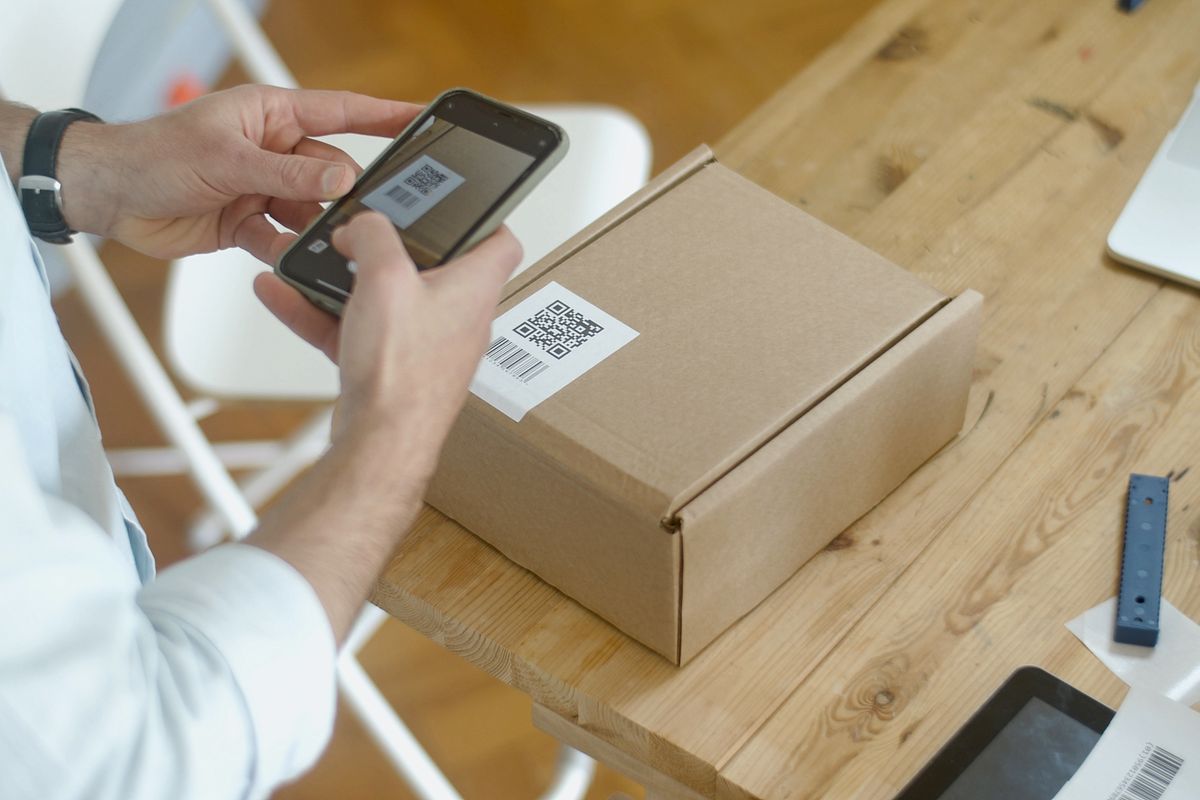
QR code (Quick Response code) is a two-dimensional barcode that can store significantly more data than traditional linear barcodes—up to 4,296 alphanumeric characters. In vacuum bag manufacturing, QR codes printed on master cartons, pallet labels, and even individual pouch packaging enable instant digital lot verification.
A QR code printed on a master carton can encode:
- The full lot number
- Production date and expiry date
- Material certifications (FDA, EU food contact, ISO standards)
- A URL link to the digital Certificate of Analysis (CoA)
- Country of origin declaration
- HS code for customs clearance
For B2B importers, QR-coded shipments mean your receiving warehouse can scan one code and immediately verify that the shipment matches the purchase order, pull up all quality documentation, and log the lot into your own inventory management system—without manual data entry or paperwork errors.
The key operational advantages of QR code lot tracking include:
- Receiving speed: Scan a pallet label in 2 seconds vs. manually recording lot numbers for 10 minutes per pallet
- Recall precision: Identify affected lots in seconds, notify only affected customers, avoid broad-market recalls
- Audit readiness: Present complete traceability reports to auditors or customers on demand
- Counterfeit prevention: Unique QR codes make it difficult for unauthorized resellers to pass off non-certified products as genuine
- Integration with ERP/WMS: QR data flows directly into enterprise systems without transcription errors
Ask your vacuum bag supplier: “Do you provide QR-coded master carton labels with embedded lot traceability and CoA links?” Suppliers who have invested in this capability demonstrate a commitment to supply chain transparency that paper-based systems cannot match.
Recall Readiness: Why Your Supplier’s Traceability Protects Your Business
Food contact vacuum bags sold into EU, US, and Australian markets are subject to regulatory recall requirements. Under EU Regulation (EC) No 178/2002 (General Food Law), food business operators must be able to identify any person from whom they have been supplied and any business to which their products have been supplied—the so-called “one step back, one step forward” principle.
When a recall is triggered—whether due to a resin contamination incident, printing ink migration issue, or packaging integrity failure—the cost difference between targeted and broad recall is dramatic:
| Scenario | Recall Scope | Estimated Cost |
|---|---|---|
| Strong traceability system | Targeted: only affected lots (e.g., 2 of 50 lots) | $50,000–$150,000 |
| Weak traceability system | Broad: all production within a date range (e.g., 6 months of output) | $500,000–$2,500,000+ |
Beyond direct costs, a broad-market recall damages retailer relationships, triggers negative press coverage, and can result in delisting from major accounts. For private-label vacuum bag programs sold through big-box retail or e-commerce platforms (Amazon, Walmart), even a single recall can terminate a years-long supplier relationship.
Your supplier’s traceability system is your first and best line of defense. Before placing a production order, verify:
- Does the supplier maintain lot-level traceability from resin to finished pouch?
- Can they complete a mock recall exercise within 4 hours?
- Do their production batch records link material lots, machine parameters, and operator IDs?
- Are lot numbers printed on every master carton and available digitally (QR code)?
- Is the traceability system documented in their ISO 9001 quality manual?
The Cost of Skipping Lot Control: Real-World Consequences
Importers who source vacuum bags from suppliers without robust lot control face concrete business risks that extend far beyond quality complaints:
- Customs detention: EU and US customs authorities increasingly require lot-level traceability documentation for food contact materials. Shipments without traceable lot records may be held at port—costing demurrage fees of $150–$500 per day per container.
- Retailer compliance audits: Major retailers (Walmart, Costco, Carrefour, Aldi) require suppliers to pass third-party social compliance and quality audits that include traceability verification. A failed audit can mean immediate delisting.
- Liability exposure: Without lot traceability, a single quality incident can implicate all your inventory. Your product liability insurance may require traceability as a condition of coverage.
- Inventory obsolescence: Without FIFO lot control, older inventory may be shipped before newer stock, increasing the risk of customer returns due to aging material—plastic films can degrade over time.
Qingdao Sanyuan maintains full ISO 9001:2015 certified lot traceability from incoming resin inspection through finished product shipment. Every vacuum bag pouch is traceable to its originating raw material batch, production line, operator shift, and QC inspection record.
FAQ: Vacuum Bag Batch Traceability & Lot Control
What is the difference between a batch, lot, and serial number?
A batch and lot are often used interchangeably—both refer to a group of products manufactured under the same conditions. A serial number is a unique identifier assigned to an individual unit. In vacuum bag production, lot numbers are standard because bags are produced in batches; serial numbers are rare unless required for high-value industrial or medical applications.
How long should vacuum bag traceability records be retained?
ISO 9001 does not specify a fixed retention period, but industry best practice is minimum 3 years for non-food contact industrial bags and 5–7 years for food contact vacuum bags. EU food contact regulations effectively require traceability records for the shelf life of the product plus an additional period for recall investigation—typically 5 years minimum.
Can a small vacuum bag factory implement lot traceability?
Yes. The core requirements—assigning lot numbers at receiving, recording lot consumption in production, and linking finished goods to raw material lots—can be implemented with structured spreadsheets for operations up to 10–15 employees. As volume grows, dedicated ERP/MRP systems become necessary. The critical factor is discipline, not software.
What should I look for when auditing a supplier’s traceability system?
Request a live mock recall: provide the supplier with a finished product lot number from a shipment 6–12 months ago and ask them to trace it backward to all raw material lots within 4 hours. Evaluate their response time, completeness of records, and whether lot numbers match across receiving, production, QC, and shipping documents.
Does QR code traceability add cost to vacuum bag orders?
The incremental cost of QR code labels on master cartons is negligible—typically $0.01–$0.05 per carton. The value comes from reduced receiving labor, faster recall response, and audit readiness. For most B2B importers, QR code lot tracking pays for itself many times over through operational efficiency gains.
Related reading:
- Vacuum Bag Industry Standards: ISO, ASTM & EN Guide
- Vacuum Bag Customs Clearance Guide: Avoiding Seizures & Delays
- Vacuum Bag Cross-Border Compliance: GPSR, UKCA & Prop 65
- Container Loading Optimization for Vacuum Bag Shipments
- EPR & Extended Producer Responsibility for Vacuum Bags in the EU
Disclaimer: This article provides general information for B2B sourcing professionals. Consult your quality management team and legal counsel for guidance specific to your product category and regulatory jurisdiction.