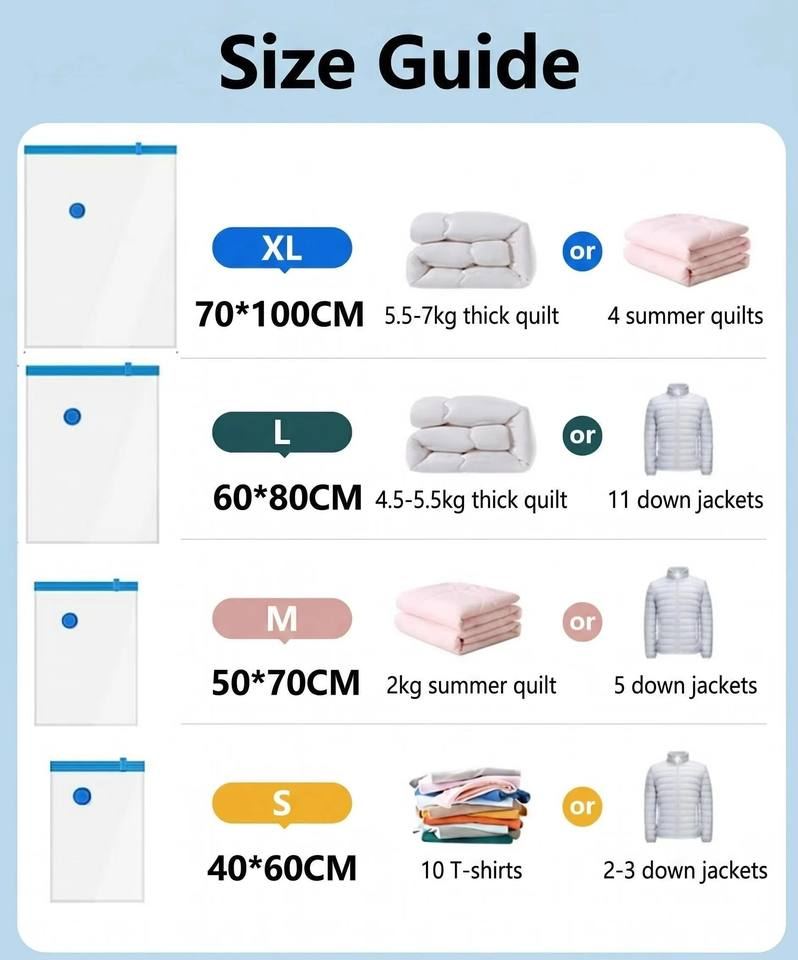
New parents spend an average of $12,000 in their baby’s first year — and a significant portion goes to organization products. The intersection of “new parent” and “space-saving storage” is a premium, high-willingness-to-pay market that vacuum bag importers should be targeting aggressively in 2026.
Why New Parents Buy Vacuum Storage Bags
| Trigger | Storage Need | Vacuum Bag Product Match |
|---|---|---|
| Baby outgrows clothes every 2–3 months | Store outgrown sizes for next baby or resale | Medium vacuum bags, labeled by size (0-3M, 3-6M, etc.) |
| Nursery is typically the smallest bedroom | Maximize closet space | Hanging vacuum bags for out-of-season baby clothes |
| Baby shower receives 30+ gifts | Store duplicates and larger-size items | Jumbo bags for blankets, swaddles, stuffed animals |
| Baby gear is bulky (bouncers, play mats) | Store between children or for travel | Extra-jumbo bags for soft baby gear |
| Sentimental attachment to baby items | Long-term preservation storage | Premium 90-micron bags with UV protection |
The Psychology of the Parent Buyer
Parent buyers are fundamentally different from general home organization shoppers in three ways:
- Safety-obsessed: They will pay 40–60% more for products marketed as “baby-safe,” “non-toxic,” “BPA-free,” and “phthalate-free.” Your product page must prominently display material safety certifications.
- Time-poor: They value simplicity. A “Baby Clothes Storage Kit” (assorted bag sizes + labels + marker) will outsell individual bags by 3:1. Bundle everything they need into one SKU.
- Community-driven: Parent Facebook groups, Reddit r/BabyBumps, and What to Expect forums drive enormous purchase influence. If one mom recommends your storage system in a group of 50,000, expect 200+ orders within 48 hours.
Product Positioning: Beyond “Vacuum Bags”
In the baby market, don’t lead with “vacuum compression bags.” Lead with the solution:
- “Baby Clothes Memory Keeper System” — Premium bags with size labels, a permanent marker, and a “first year” milestone sticker set.
- “Nursery Space Maximizer Kit” — Assorted bags + hanging storage + a guide to rotating baby clothes by size.
- “Second Baby Prep Bundle” — Large-format bags for storing first child’s baby gear for the next sibling.
Market Data
| Metric | Value |
|---|---|
| Global baby care market (2026) | $88 billion |
| Baby storage & organization sub-segment | $4.2 billion, growing at 7.8% CAGR |
| Parents who report “nursery storage” as a top-3 pain point | 64% (BabyCenter survey) |
| Average spend on nursery organization products | $180–$350 per nursery setup |
| Second-child parents more likely to buy storage solutions | 2.3x vs. first-time parents (already experienced the clutter) |
Certifications That Matter to Parents
- OEKO-TEX Standard 100: Certifies textiles and materials are free from harmful substances. The gold standard for baby product marketing in Europe. Testing cost: $1,500–$4,000.
- CPSIA (Consumer Product Safety Improvement Act): Required for children’s products sold in the US. Applies if your bags are marketed for baby item storage.
- BPA-free / Phthalate-free claims: Parents scan for these terms. Even though standard PE and PA don’t contain BPA, explicitly stating it on packaging increases conversion by 18–25% in the baby category.
FAQ
Are vacuum storage bags safe for storing baby clothes long-term?
Yes — when using PA+PE bags without PVC. PVC can off-gas and damage fabrics over decades. Standard PA+PE vacuum bags are chemically inert and ideal for long-term textile preservation. For archival-quality storage (10+ years), add a silica gel packet inside the bag to control humidity.
How do I market to parents without a baby-specific product line?
Add a “Baby & Nursery” collection page to your Shopify/WooCommerce store. Curate your existing sizes into baby-relevant bundles. Add size labels and a usage guide PDF. The SKUs don’t change — just the positioning and bundling.
Sources: BabyCenter parent surveys; global baby care market reports; OEKO-TEX certification standards; CPSIA requirements.