TL;DR: Travel vacuum compression bags (hand-roll, no pump) and home vacuum storage bags (vacuum cleaner required) serve fundamentally different markets with distinct size ranges, material thicknesses, and valve technologies. Travel bags prioritize portability with 50–70cm lengths, 7–9 mil PA+PE film, and one-way roll valves, while home bags emphasize maximum compression with 80–130cm lengths, 9–15 mil multi-layer film, and turbo air valves designed for vacuum cleaner attachment. This guide compares both categories across 10 technical dimensions, maps regional market preferences (Europe prefers travel; North America and Middle East favor home), and provides a B2B product line planning framework for importers and retailers.
What Are the Fundamental Differences Between Travel and Home Vacuum Bags?
Before comparing sizes and features, it is essential to define the two product categories precisely:
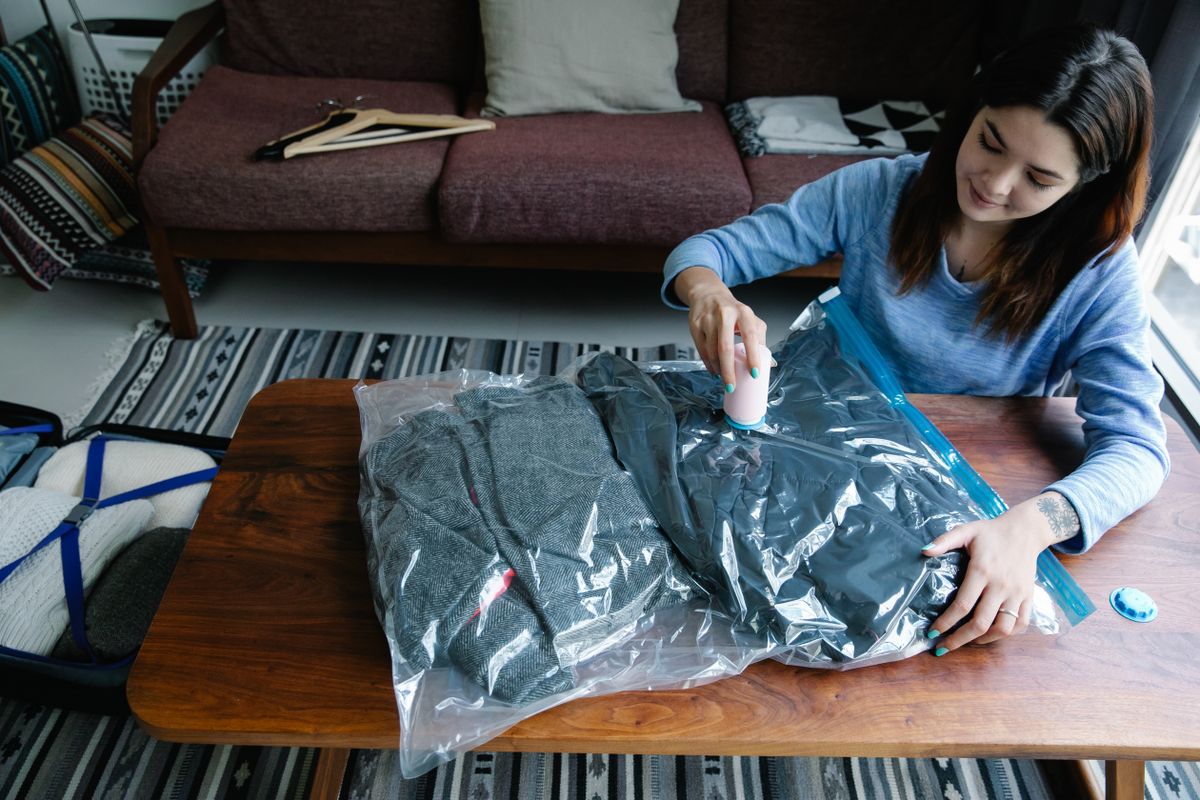
Travel vacuum compression bags (also called roll-up compression bags, hand-roll vacuum bags, or travel space-saver bags) use a one-way air valve and manual rolling action to expel air — no external vacuum pump or vacuum cleaner is required. The user places clothing inside, seals the double-rail zip closure, and rolls the bag from the sealed end toward the valve. Air escapes through the one-way valve while the user’s body weight and rolling pressure create compression. These bags typically reduce volume by 50–65% and are designed for suitcase portability.
Home vacuum storage bags (also called vacuum cleaner compression bags, household space-saver bags, or pump vacuum bags) require an external vacuum source — usually a standard household vacuum cleaner hose nozzle or a dedicated electric/manual pump — to extract air through a turbo valve. The vacuum creates negative pressure inside the sealed bag, achieving maximum compression of 70–80% volume reduction. These bags are designed for long-term closet, under-bed, and attic storage of seasonal clothing, bedding, and soft goods.

Why Do Size Ranges Differ So Dramatically Between Travel and Home Bags?
The size difference between travel and home vacuum bags is not arbitrary — it reflects the constraints of their respective use environments. Travel bags must fit inside standard carry-on and checked luggage, which imposes a hard size ceiling. Home bags, by contrast, are only limited by closet shelf depth and the practical weight of a compressed bundle one person can lift.
Standard Travel Compression Bag Sizes
| Size Designation | Dimensions (W × L) | Fits Inside | Capacity Guide |
|---|---|---|---|
| Travel Small | 40 × 50 cm (16 × 20 in) | Carry-on, backpack | 4–6 t-shirts + underwear; or 1–2 lightweight sweaters |
| Travel Medium | 50 × 60 cm (20 × 24 in) | Carry-on, 22″ suitcase | 8–10 t-shirts; or 2–3 sweaters + 1 pair jeans |
| Travel Large | 60 × 70 cm (24 × 28 in) | 24–26″ checked luggage | 12–15 t-shirts; or 4–5 sweaters; or 1 lightweight jacket + clothes |
| Travel XL (limited) | 70 × 80 cm (28 × 31 in) | 28–30″ large checked luggage | Bulkier items — winter coat + 2 sweaters + scarf |
Standard Home Vacuum Storage Bag Sizes
| Size Designation | Dimensions (W × L) | Typical Use | Capacity Guide |
|---|---|---|---|
| Home Medium | 70 × 50 cm (28 × 20 in) | Seasonal clothing, towels | 10–15 garments; or 4–6 thick towels |
| Home Large | 80 × 60 cm (31 × 24 in) | Bulky winter wear, pillows | 6–8 bulky sweaters; or 2 standard pillows + clothes |
| Home Extra Large | 100 × 70 cm (39 × 28 in) | Double duvets, bedding sets | 1 double duvet + 2 pillows; or full bedding set + curtains |
| Home Jumbo | 130 × 100 cm (51 × 39 in) | King duvets, multi-season storage | 1 king duvet + pillows; or entire winter wardrobe |
The dimensional crossover zone is the 70 × 50–80 cm range, where both travel and home bags overlap. However, even when dimensions appear similar, the material construction, valve design, and intended compression method make them functionally distinct products.
How Do Material Thickness and Construction Compare Between Travel and Home Bags?
Material requirements for travel vs. home vacuum bags diverge significantly due to different stress profiles. Travel bags experience repeated folding, suitcase abrasion, and manual rolling pressure concentrated along crease lines. Home bags face sustained negative pressure over months of static storage, with less mechanical manipulation but longer exposure to environmental factors like humidity, temperature fluctuations, and attic/garage conditions.
Material Comparison Table
| Property | Travel Roll-Up Bags | Home Vacuum Cleaner Bags |
|---|---|---|
| Material Structure | PA+PE 5-layer or 7-layer co-extruded film | PA+PE 7-layer to 9-layer; some premium use PA+PET+PE |
| Total Thickness | 7–9 mil (175–225 microns) | 9–15 mil (225–375 microns); heavy-duty up to 18 mil |
| PA (Nylon) Layer Content | 15–20% (prioritizes flexibility over absolute barrier) | 20–30% (maximizes gas barrier for long-term storage) |
| OTR (Oxygen Transmission Rate) | 15–25 cc/m²·day (adequate for 1–4 week travel) | 5–12 cc/m²·day (necessary for 6–12 month storage) |
| Puncture Resistance | Moderate — designed for textile-only contact | High — must resist zipper, button, and hanger punctures |
| Flexural Fatigue Resistance | High — must survive repeated folding/rolling | Moderate — mostly stays flat after initial compression |
| Valve Type | One-way flat film valve (passive); some use double one-way valves | Turbo air valve (active); compatible with 32–35mm vacuum cleaner nozzles; some include manual pump port |
| Zip Closure Type | Double-rail zipper with slider clip; emphasis on easy-open/easy-close for daily use | Double-rail zipper or triple-seal track; emphasis on long-term hermetic seal integrity |
| Reusability Cycles | 20–50 cycles (limited by crease wear) | 10–20 cycles (limited by zip seal degradation over time) |
| Volume Reduction | 50–65% | 70–80% |
Key technical insight for B2B buyers: The PA (polyamide/nylon) layer percentage is the single most important spec to verify with your manufacturer. PA provides the gas barrier properties that prevent air from re-entering the bag over time — the defining performance characteristic of any vacuum storage bag. A travel bag with 15% PA content will hold compression adequately for a 2-week trip but may slowly re-inflate over 3–4 weeks. A home bag with 25% PA content should maintain compression for 6–12 months. For more on material science, see our Vacuum Bag Materials Comparison: PA, PE, PET, Nylon & TPU.
Which Markets Prefer Travel Bags and Which Prefer Home Bags?
Regional consumer behavior and retail channel dynamics heavily influence which product category dominates in a given market. B2B importers planning their product mix should align inventory with these geographic preferences.
| Market Region | Preference | Key Drivers | Recommended SKU Mix |
|---|---|---|---|
| Western Europe (Germany, UK, France, Nordics) | 55% Travel / 45% Home | Strong budget airline culture (Ryanair, EasyJet carry-on only); smaller average home sizes; sustainability-conscious consumers prefer reusable travel bags | Travel S/M/L + Home L/XL; eco-friendly packaging; emphasize reusability |
| North America (USA, Canada) | 35% Travel / 65% Home | Larger homes with storage space (attics, basements, garages); seasonal wardrobe rotation culture; strong “home organization” retail category (Container Store, Walmart, Amazon) | Home M/L/XL/Jumbo + Travel M/L; Jumbo size is critical for bedding |
| Middle East & GCC (UAE, Saudi Arabia, Qatar) | 30% Travel / 70% Home | Large villas with dedicated storage rooms; biannual wardrobe rotation (summer/winter); high disposable income; preference for premium/thick materials | Home L/XL/Jumbo (12+ mil) + premium hanging suit bags; minimal travel SKUs |
| Southeast Asia (Indonesia, Thailand, Vietnam, Philippines) | 40% Travel / 60% Home | Humidity-driven demand for moisture-barrier storage; smaller homes but strong seasonal storage need (monsoon gear, winter travel clothes); price-sensitive market | Home M/L + Travel S/M; value combo packs (multiple sizes in one SKU); emphasize anti-mold/anti-humidity |
| Latin America (Brazil, Mexico, Chile) | 45% Travel / 55% Home | Growing e-commerce market (Mercado Libre); domestic travel culture; apartment living in urban centers drives space-saving demand | Balanced mix; Travel M/L + Home M/L; Spanish/Portuguese packaging |
For importers serving multiple regions, the data suggests a baseline product line of 7–8 SKUs covering both categories. For more on how these bags are manufactured, see our Factory Tour: How Vacuum Compression Bags Are Made.
Product Line Planning: How Should B2B Buyers Build Their SKU Mix?
For importers, distributors, and retail chains developing a private-label or branded vacuum bag product line, the optimal SKU mix balances market coverage with inventory efficiency. Below is a recommended framework based on real-world B2B purchasing patterns observed at Qingdao Sanyuan across 200+ buyer relationships.
Entry-Level Product Line (4–6 SKUs)
Ideal for first-time importers testing the market or e-commerce sellers launching a branded Amazon/eBay store:
- 1 × Travel Medium (50×60cm) — highest-volume travel SKU globally
- 1 × Travel Large (60×70cm) — covers carry-on and small checked luggage
- 1 × Home Medium (70×50cm) — entry-level home storage
- 1 × Home Large (80×60cm) — covers most clothing/pillow use cases
- 1 × Home Extra Large (100×70cm) — bedding storage
- Optional: 1 × Combo Pack (variety of 3–4 sizes) — high-conversion retail SKU
Mid-Market Product Line (8–12 SKUs)
For established importers supplying retail chains or multi-channel e-commerce:
- All 4 travel sizes (S, M, L, XL)
- All 4 home sizes (M, L, XL, Jumbo)
- 1–2 × Hanging Suit Bags (travel + home variants)
- 1–2 × Combo/Variety Packs (differentiated by category: “Travel Kit,” “Home Storage Kit”)
- Optional: 1 × Electric pump accessory SKU (high-margin add-on, especially for home bag lines)
Premium/Full-Range Product Line (15+ SKUs)
For large retail chains (Walmart, Target, Carrefour, Metro) or dominant regional distributors:
- Full size range in both travel and home categories (8+ sizes)
- Multiple thickness tiers within the same size (e.g., Home Large in 9 mil economy and 12 mil premium)
- Hanging bags in multiple lengths (90cm, 110cm, 135cm)
- Specialty SKUs: food-grade vacuum bags, outdoor/camping compression sacks, baby item storage bags
- Electric and manual pump accessories (2–3 SKUs)
- Seasonal packaging variants (Christmas storage, back-to-college, spring cleaning)
For retail packaging strategy guidance across different channels, see our Vacuum Bag Retail Packaging Strategies. For camping and outdoor gear applications, visit our Camping & Outdoor Gear Vacuum Storage Bags Guide.
FAQ: Travel vs Home Vacuum Bags
Can travel roll-up bags be used for home storage?
Technically yes, but with significant limitations. Travel bags typically use thinner 7–9 mil film with lower PA (nylon) content, meaning they will slowly re-inflate over 3–6 weeks as ambient air permeates through the film. They also lack the turbo valve needed for vacuum cleaner attachment, so maximum compression is limited to 50–65% versus 70–80% with home bags. For storage exceeding one month, dedicated home vacuum bags are strongly recommended.
Can home vacuum bags be used for travel if I bring a pump?
Yes, and this is a growing niche. Some travelers — particularly those on extended trips, ski vacations, or family holidays — bring a compact USB-rechargeable electric pump (140–160g) and 1–2 home-style vacuum bags for maximum compression. However, home bags are physically larger (80cm+ length) and made of thicker, less flexible material that does not fold as neatly into suitcase corners. For most B2B product lines, a dedicated travel SKU plus a compact electric pump accessory captures this use case.
What mil thickness should I specify for each category?
For travel roll-up bags: 7–9 mil (175–225 microns) is the industry standard. Below 7 mil, bags develop pinhole leaks at fold creases within 5–10 uses. Above 9 mil, the material becomes too stiff for effective manual rolling and adds unnecessary packaging weight. For home vacuum bags: 9–11 mil is standard for medium and large sizes; 11–15 mil is recommended for extra-large and jumbo sizes holding heavy bedding. Premium home lines targeting the Middle East or luxury retail should specify 12–15 mil minimum.
Which valve type performs better for long-term storage?
Turbo air valves (used on home bags) significantly outperform one-way flat film valves (used on travel bags) for long-term seal integrity. The turbo valve’s mechanical cap creates a positive seal after vacuum extraction, whereas one-way valves rely on the internal negative pressure to stay closed — meaning any slow air ingress eventually breaks the seal. For storage exceeding 3 months, turbo valve systems with screw-cap or snap-cap closures are essential.
How do I verify material quality claims from a manufacturer?
Request third-party lab test reports for OTR (ASTM D3985), WVTR (ASTM F1249), tensile strength (ASTM D882), and puncture resistance (ASTM F1306). Reputable manufacturers like Qingdao Sanyuan provide these as standard with initial sample shipments. Cross-check the reported PA layer percentage against the OTR value — a claimed 25% PA content should correlate with an OTR below 10 cc/m²·day at 23°C/50% RH. For more on material verification, see our Comprehensive Vacuum Bag Comparison Table.
Key Takeaways
- Two distinct product categories: Travel bags (50–65% compression, hand-roll, 7–9 mil, 40–80cm lengths) and home bags (70–80% compression, vacuum cleaner powered, 9–15 mil, 70–130cm lengths) serve fundamentally different consumer needs and should not be treated as interchangeable in a B2B product line.
- Material specs drive performance: PA layer content, total film thickness, OTR, and valve design are the four critical specifications that differentiate quality tiers. Do not evaluate bags on size alone.
- Regional preferences are measurable: Europe skews toward travel bags; North America and the Middle East toward home storage; Southeast Asia favors value-oriented mixed packs. Plan your import SKU mix accordingly.
- Product line depth scales with market ambition: Entry-level importers can validate the market with 4–6 SKUs; mid-market distributors need 8–12; full-range retail suppliers require 15+ with thickness and accessory variants.
- Qingdao Sanyuan can support your product line: We manufacture both travel roll-up and home vacuum cleaner bags in all standard sizes with customizable material thickness, valve types, printing, and packaging. Contact our team to discuss your product line requirements and receive tailored samples within 7–10 business days.