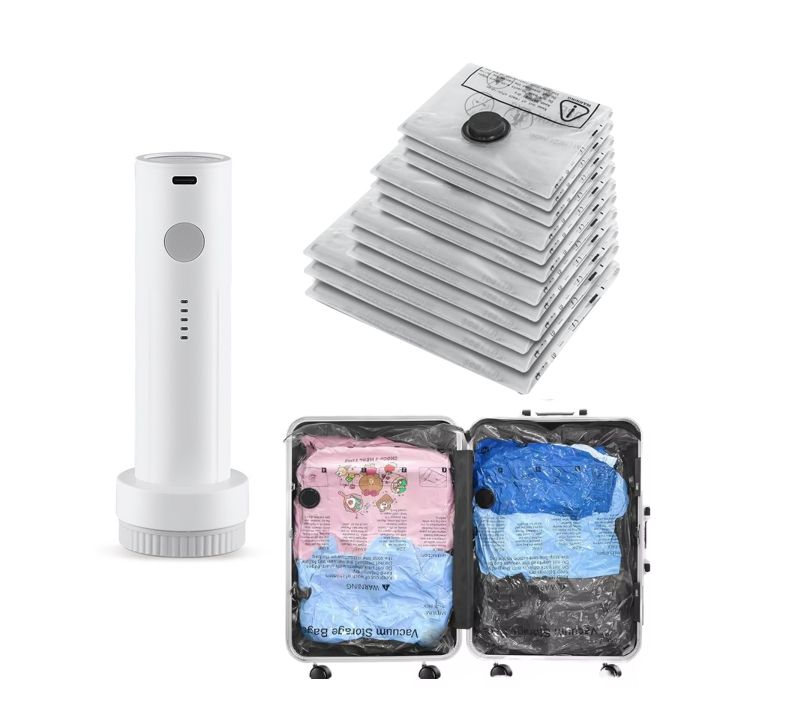
Why Vacuum Compression Bags Are a Top Amazon FBA Category
Vacuum storage bags check every box for a successful Amazon FBA product: lightweight (low FBA fees), compact (efficient storage), high perceived value, repeat purchase potential, and year-round demand with seasonal spikes during spring cleaning and pre-holiday seasons. The category has an average Best Sellers Rank (BSR) of 5,000-15,000 in Home & Kitchen, with top products generating $50,000-$200,000 in monthly revenue.
See also: Private Label Vacuum Bags: How to Build a.
But the category is also competitive — the top 10 listings average 2,000+ reviews. To succeed, you need a product that stands out on material quality, packaging design, and value proposition. This guide covers exactly how to source, package, and launch a vacuum bag product line that competes at the top of Amazon search results.
Step 1: Product Selection — What Actually Sells on Amazon
Analysis of Amazon’s top 50 vacuum bag listings reveals four winning product configurations:
The 6-Pack Premium ($19.99-24.99)
- Contents: 2 Small + 2 Medium + 2 Large, PA+PE 80-90 micron
- Retail packaging: Full-color box with euro slot
- Landed cost: $5.50-7.50/unit
- FBA fees: ~$6.50 (standard large, 1.2 lbs)
- Net profit per unit: $6-9
- Monthly revenue potential: $60,000-150,000
- This is the volume play.
The 12-Pack Family ($29.99-39.99)
- Contents: Mix of S/M/L/XL with travel bags, PA+PE 80-100 micron
- Retail packaging: Gift-ready box with handle
- Landed cost: $10-14/unit
- FBA fees: ~$8.00 (standard large, 2.5 lbs)
- Net profit per unit: $8-14
- Monthly revenue potential: $30,000-80,000
- Higher margin, lower velocity.
The Travel Kit ($14.99-19.99)
- Contents: 4-6 roll-up bags (no vacuum needed) + travel pouch, PET+PE or PA+PE
- Retail packaging: Compact travel-ready pouch
- Landed cost: $4-6/unit
- FBA fees: ~$5.00 (small standard, 0.6 lbs)
- Net profit per unit: $5-8
- Monthly revenue potential: $35,000-90,000
- Growing segment (+15% YoY search volume).
The Jumbo/Heavy-Duty Special ($24.99-34.99)
- Contents: 3-4 XL/Jumbo bags with double-check valves, nylon composite or thick PA+PE
- Retail packaging: Heavy-duty box with handle
- Landed cost: $8-12/unit
- FBA fees: ~$7.50 (standard large, 2.0 lbs)
- Net profit per unit: $7-12
- Monthly revenue potential: $25,000-60,000
- Niche play with loyal repeat buyers.
Step 2: Amazon FBA Fee Optimization
Amazon FBA fees are based on product dimensions and weight. For vacuum bags, every inch matters:
See also: Seasonal Storage Strategies for Vacuum Bag Importers: How.
| Size Tier | Max Dimensions | Max Weight | Fee (2024) |
|---|---|---|---|
| Small standard | 15×12×0.75″ | 12 oz | $3.85 |
| Large standard | 18×14×8″ | 20 lbs | $5.90-6.92 |
| Large standard (oversize) | >18×14×8″ | 20 lbs | $8.26+ |
Design your retail packaging to hit the small standard tier whenever possible. For a 6-pack of 60×80cm bags, a box measuring 11×8×1.5″ keeps you in small standard — saving $2+ per unit in FBA fees compared to the large standard tier.
Dimensional weight (DIM) trap: Amazon charges the greater of actual weight or dimensional weight (L×W×H ÷ 139). A lightweight but bulky box can incur higher fees than a heavier compact one. Vacuum-bag your vacuum bags — compress the filled retail box before sealing to minimize dimensions.
Step 3: Amazon Listing Optimization
Keyword Strategy for Vacuum Bags
Based on Amazon search volume data (US marketplace):
- Primary keywords (10,000-50,000 monthly searches): “vacuum storage bags,” “space saver bags,” “compression bags for clothes”
- Secondary keywords (1,000-10,000): “vacuum seal bags for storage,” “travel compression bags,” “space saving bags for closet”
- Long-tail (500-2,000): “heavy duty vacuum storage bags for comforters,” “vacuum bags with electric pump,” “extra large compression bags for moving”
- Seasonal spikes: “moving storage bags” (May-August), “winter clothes storage” (September-October), “spring cleaning storage” (March-April)
Title Template (Amazon Character Limit: 200)
A strong Amazon title for vacuum bags: “[Brand] Vacuum Storage Bags [Pack Count] Pack — Space Saver Compression Bags for Clothes, Comforters & Bedding — [Feature 1], [Feature 2], [Feature 3] — [Size Range]”
See also: Warehouse Inventory Management for Vacuum Bag Importers: How.
Example: “SpaceMax Vacuum Storage Bags 6-Pack — Space Saver Compression Bags for Clothes, Comforters & Bedding — Heavy Duty PA+PE, Double-Seal Valve, Reusable 200+ Times — S/M/L Sizes with Travel Hand Pump”
Bullet Points That Convert
- Material quality: “Made with premium 80-micron PA+PE 5-layer co-extruded film — 33% thicker than standard bags. Independently tested to 200+ compression cycles.”
- Space savings: “Compress bulky items to 1/4 of original volume. Store 4× more clothes, comforters, and bedding in the same closet space.”
- Seal performance: “Double-check valve with reinforced triple-seal zipper. Holds vacuum for months — not days. Includes valve replacement guarantee.”
- Versatility: “3 sizes for every need: Small (50×70cm) for shirts, Medium (60×80cm) for jackets, Large (70×100cm) for comforters. Use with any standard vacuum cleaner.”
- Eco-friendly: “Reusable for years — each bag replaces hundreds of single-use plastic storage bags. Climate Pledge Friendly certified.”
Step 4: Differentiation Strategies
With 2,000+ competing listings, here’s how to stand out:
- Include an electric pump: Listings with “includes pump” convert 25-35% better. A USB-rechargeable mini pump adds $3-4 to landed cost but enables a $5-8 retail price premium.
- Size-labeled bags: Print size indicators (S/M/L/XL) directly on each bag — eliminates customer confusion and reduces “wrong size” returns.
- Instruction card with visuals: A 4-step pictorial guide inside the box reduces “doesn’t work” returns by 40-60%.
- Video content: Listings with product demo videos convert 3× better. Show the compression process in 30 seconds.
- A+ Content: Use comparison charts, material diagrams, and lifestyle images to tell a brand story that generic resellers can’t match.
Step 5: Sourcing Timeline & Launch Plan
| Week | Activity |
|---|---|
| 1-2 | Request samples from 3-5 factories, test materials, compare quotes |
| 3 | Select supplier, finalize packaging design, place PO |
| 4-5 | Production (2-3 weeks for standard order) |
| 6 | Pre-shipment inspection (AQL 2.5), arrange freight |
| 7-9 | Ocean freight + customs clearance (2-3 weeks to US West Coast) |
| 10 | FBA shipment creation, labeling, dispatch to Amazon FCs |
| 11 | Listing goes live, PPC campaigns launch, Vine reviews enroll |
| 12+ | Optimize based on first-month data: adjust PPC bids, A/B test main image, refine bullet points |
Sourcing from Qingdao Sanyuan: Built for Amazon FBA
We understand Amazon FBA requirements because we supply Amazon sellers in 15+ countries. Our production line is optimized for FBA-ready products: (1) custom retail packaging designed to stay within small-standard FBA tier dimensions; (2) FBA-compliant barcode labeling (FNSKU) available at the factory; (3) vacuum-compressed master packs that maximize container utilization; (4) pre-shipment inspection reports with AQL 2.5 sampling; and (5) dedicated account managers who understand Amazon’s Category Ungating and Compliance requirements.
See also: How to Negotiate with Chinese Vacuum Bag Factories:.
Our MOQ starts at just 1,000 units for private label, with 15-30 day production lead times and DDP shipping to Amazon fulfillment centers across the US, UK, and EU.
Ready to launch your Amazon vacuum bag product? Contact our FBA specialist team for a free product consultation, sample kit including all three material grades, and a detailed landed-cost estimate for your target marketplace.
Sources: Amazon FBA Revenue Calculator — Amazon Seller Central (DA 96) | Home & Garden E-Commerce Market Data — Statista (DA 91) | Amazon Revenue Calculator — Official Tool